Digital Arrest Fraud in India - A Citizen Awareness Note
Abstract
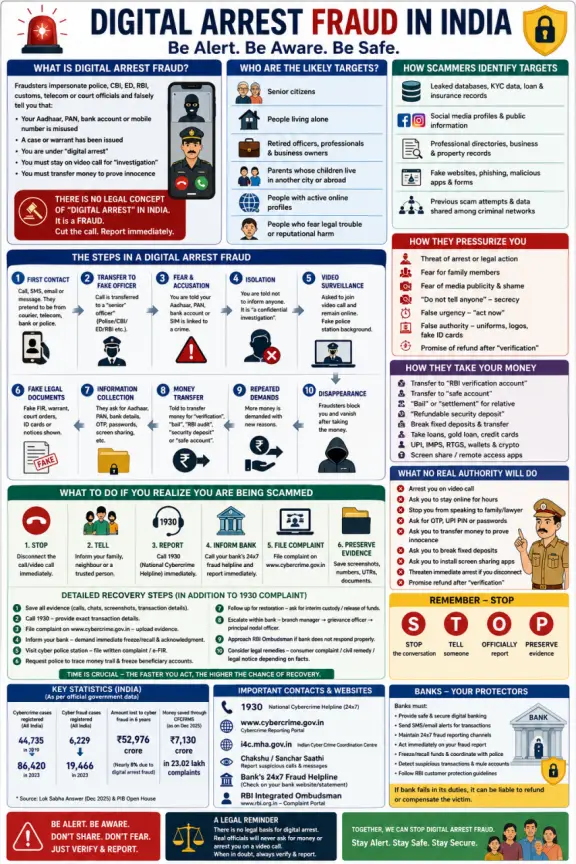
Digital arrest is a cyber fraud where scammers impersonate police, CBI, ED, RBI, court or other authorities and falsely threaten victims with arrest or criminal action. No real authority will arrest anyone on video call, ask them to stay online, stop them from speaking to family or lawyers, or demand OTPs, passwords or bank details. No government agency will ask a person to transfer money to prove innocence, verify funds, avoid arrest, or move money to a “safe” or “RBI” account. Victims must immediately disconnect the call, inform a trusted person, preserve evidence, call 1930, report on www.cybercrime.gov.in, and notify their bank. The key message is simple: Digital arrest is not legal, it is a scam. Do not panic, do not pay, verify and report immediately.
Vaishali Bhagwat, Advocate
1. The most important message
There is no legal concept called “digital arrest” in India.
No police officer, CBI officer, ED officer, RBI officer, customs officer, court officer, narcotics officer or telecom officer can legally arrest a person through a video call, WhatsApp call, Skype call, phone call or online meeting.
If someone tells you that you are under “digital arrest”, asks you to stay alone on a video call, forbids you from speaking to your family or lawyer, or asks you to transfer money to prove your innocence, it is a fraud.
Cut the call. Call 1930, India’s cybercrime helpline number, immediately. Inform your bank immediately. Inform your family or a trusted person immediately.
2. What is digital arrest fraud?
Digital arrest fraud is a form of extortion and impersonation fraud. The victim is contacted by fraudsters pretending to be police officers, CBI officers, ED officials, RBI officers, customs officials, narcotics officers, telecom officials or court officers.
The fraudsters falsely tell the victim that:
- Their Aadhaar, PAN, mobile number or bank account has been misused.
- A parcel in their name contains drugs, fake passports, illegal items or contraband.
- Their bank account is linked to money laundering or terrorist funding.
- Their SIM card or mobile number has been used for illegal activity.
- Their son, daughter or relative has been arrested.
- A warrant, summons or criminal case has been issued against them.
- They must remain on video call for “verification”, “interrogation” or “digital custody”.
The victim is then kept under fear, surveillance and pressure. The fraudsters create an atmosphere of authority by using fake ID cards, forged notices, fake court orders, police station backgrounds, uniforms, government logos and legal language.
The purpose is simple:
To frighten the victim into sharing personal information, disclosing bank details, breaking fixed deposits, taking loans, or transferring money to fraud accounts.
3. Who are the likely targets?
Anyone can become a victim. Educated, financially independent and professionally successful people have also been targeted. Digital arrest fraud works because it uses fear, urgency and authority.
However, some groups are more vulnerable:
Senior citizens
Senior citizens are often targeted because they may have savings, pensions, fixed deposits, retirement funds or family members living away from them.
People living alone
A person staying alone may not immediately consult a family member, neighbor or colleague. Fraudsters exploit isolation.
Retired government officers, bank officers and professionals
Retired officers, doctors, lawyers, chartered accountants, professors, business owners and senior professionals may be targeted because their profiles are visible and fraudsters assume that they have savings and reputation to protect.
Parents whose children live in another city or abroad
Fraudsters may falsely claim that a child has been detained, arrested or implicated in a case, this is believable as parents do not have immediate contact with their children and may not be aware of their whereabouts.
People with active online profiles
People who share travel, family, profession, job status, property, business or contact information online may unknowingly provide useful material to scammers.
People who fear legal trouble or reputational harm
Fraudsters repeatedly say things like, “Do not tell anyone or your name will be published”, “Your family will be arrested”, or “Your bank account will be frozen”. This pressure is designed to prevent the victim from seeking help.
4. How do scammers identify their targets?
Fraudsters may obtain information from several sources. They do not always need full information; even partial information is enough to create fear.
Common sources include:
- Leaked databases containing phone numbers, Aadhaar linked details, PAN details, courier details, loan inquiries, insurance leads or shopping records.
- Social media profiles showing age, family details, occupation, travel, retirement, financial status or children living abroad.
- Public professional directories, business websites, LinkedIn profiles and association membership lists.
- Property, company, GST or business records available in public or semipublic databases.
- Old data collected through fake KYC forms, phishing links, loan apps, investment schemes or fake customer support calls.
- Previous scam attempts, where victim lists are circulated among criminal networks.
- Telecom misuse, spoofed numbers, mule bank accounts and fake digital identities.
A fraudster may know only your name, phone number and courier reference, but may pretend to have your Aadhaar, bank accounts and complete file. The fraud depends more on fear than on actual knowledge.
5. Warning signs of digital arrest fraud
You should treat the following as immediate red flags:
- The caller says that you are under “digital arrest”.
- The caller claims to be from the police, CBI, ED, RBI, customs, narcotics, telecom department or court.
- The caller says your Aadhaar, PAN, SIM, bank account or parcel is linked to crime.
- You are asked to join a WhatsApp, Skype, Zoom or video call.
- You are told not to disconnect the call.
- You are told not to speak to your family, lawyer, bank or local police.
- You are shown fake warrants, FIRs, court orders, ID cards or government logos.
- You are asked to share Aadhaar, PAN, bank details, OTP, UPI PIN, passwords or screen access.
- You are asked to transfer money to a “safe account”, “RBI account”, “government verification account”, “escrow account” or “security deposit account”.
- You are told that the money will be refunded after investigation.
- You are asked to break fixed deposits, take loans, sell investments or arrange money urgently.
- You are threatened with arrest, media exposure, freezing of accounts or harm to family members.
6. Typical steps in a digital arrest fraud
Step 1: The first contact
The victim receives a call, SMS, email or message. The caller may claim to be from a courier company, telecom company, police department, customs department or bank.Example:
“Your parcel has been seized because it contains drugs and fake passports. Press 1 to speak to the investigation officer.”
Step 2: Transfer to a fake officer
The call is transferred to another fraudster posing as a senior police officer, CBI officer, narcotics officer or ED officer.The victim is told that the matter is serious and confidential.
Step 3: Fear and accusation
The fraudster alleges that the victim’s Aadhaar, PAN, bank account, SIM card or phone number is linked to criminal activity.Example:
“Your Aadhaar has been used to open bank accounts involved in money laundering. You are now a suspect.”
Step 4: Isolation
The victim is told not to inform anyone.Example:
“This is a confidential investigation. If you tell your family or lawyer, you will be charged with obstruction of investigation.”
Step 5: Video surveillance
The victim is asked to join a video call and remain visible. The background may show a fake police station or government office. The fraudsters may wear uniforms or display forged documents.Step 6: Fake legal documents
The victim may receive fake FIRs, summonses, arrest warrants, freezing orders, confidentiality notices or Supreme Court/RBI/CBI letters.Please note: Police officers cannot legally serve notices or summons through informal electronic messaging platforms such as WhatsApp!!
Step 7: Collection of personal and financial information
The fraudsters ask for Aadhaar, PAN, bank account details, mobile number, email ID, passwords, OTPs, UPI PINs or screenshots of bank balances.Sometimes they ask the victim to install an app or share the phone screen, this helps them gain control of your phone.
Step 8: Money transfer
The victim is told to transfer money for “verification”, “clearance”, “bail”, “security deposit”, “RBI audit”, “fund authentication” or “temporary custody”.Step 9: Repeated extraction
Once one payment is made, more demands follow. The fraudsters may say that the earlier transfer has triggered another investigation or that more accounts must be verified.Step 10: Disappearance
After collecting money, the fraudsters disconnect, block the victim, delete accounts or move money through multiple mule accounts, making it difficult for banks to track and block transactions.7. How victims are pressured to share information or transfer money
Digital arrest fraud is not an ordinary phone scam. It is a psychological trap. The victim is made to feel trapped, watched and helpless.
Common pressure techniques
- Fear of arrest — “You will be arrested today unless you cooperate.”
- Fear for family — “Your son/daughter is also under investigation.”
- Fear of reputation — “Your name will be published in the media.”
- False confidentiality — “You cannot tell anyone because this is a sealed investigation.”
- False urgency — “You have only 30 minutes to prove that your money is clean.”
- False authority — “We are calling from the CBI/ED/RBI/police headquarters.”
- False legal language — “Your account is under surveillance under money laundering laws.”
- False refund promise — “Transfer the money to the government verification account. It will be returned after clearance.”
8. Examples of how money is taken
Example 1: “RBI verification account”
The victim is told that all funds must be transferred to an RBI monitored account to prove that the funds are not linked to crime.
Example 2: “Safe account”
The victim is told that their bank account will be frozen and they must move money to a “safe account”.
Example 3: “Bail or settlement”
The victim is told that a family member has been detained and money must be paid urgently to avoid arrest.
Example 4: “Refundable security deposit”
The victim is told that the amount is not a payment, but a refundable security deposit for investigation.
Example 5: “Fixed deposit verification”
The victim is told to break fixed deposits and transfer the amount to the investigation account.
Example 6: “Loan under pressure”
Some victims are forced to take personal loans, gold loans or credit card loans and transfer the proceeds.
Example 7: “Screen share fraud”
The victim is asked to install a screen sharing or remote access app. The fraudsters then watch the victim’s banking activity or take control of the device.
Example 8: “UPI/IMPS/RTGS layering”
The money is transferred to one account and then quickly moved to multiple accounts, wallets, payment gateways or crypto channels.
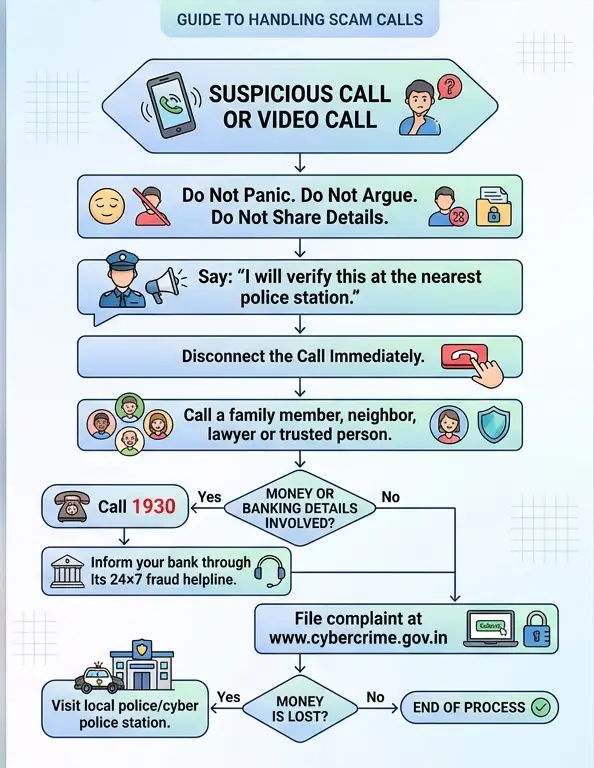
9. What should you do if you receive such a call?
Immediate response flowchart
What not to do
Do not:
- Stay on video call.
- Share Aadhaar, PAN, bank account details, passwords, OTPs or UPI PIN.
- Install any app suggested by the caller.
- Share your phone screen.
- Break fixed deposits.
- Transfer money for verification.
- Take loans.
- Keep the matter secret.
- Delete call logs, WhatsApp chats, SMSs or emails.
- Delay reporting because of embarrassment.
The first few minutes are very important. The faster the fraud is reported, the greater the chance of blocking or freezing the money trail.
10. What should a victim do after realizing money has been transferred?
The victim must act on three tracks at the same time:
- Report to 1930 and the cybercrime portal.
- Notify the bank and demand urgent fraud action.
- Follow up with police and court for freezing and restoration of money.
Step by step recovery action plan
Step 1: End contact with the fraudsters
Immediately disconnect the call. Do not continue the video call. Do not respond to further threats.Step 2: Preserve evidence
Keep the following:
- Phone numbers used by the fraudsters.
- WhatsApp numbers and profile photos.
- Screenshots of video calls.
- Fake ID cards, notices, warrants or letters.
- Bank account numbers and IFSC codes where money was transferred.
- UPI IDs.
- Transaction IDs, UTR numbers and reference numbers.
- Date and time of each call and payment.
- Call recordings, if available.
- SMS alerts and bank emails.
- Screen sharing app details, if any.
- Names used by the fraudsters.
Do not delete anything.
Step 3: Call 1930 immediately
Give exact transaction details:
- Your name and mobile number.
- Bank name.
- Amount transferred.
- Date and time of transfer.
- UTR/reference number.
- Beneficiary account number/UPI ID.
- Mode of transfer — UPI, IMPS, NEFT, RTGS, card, wallet or net banking.
Ask for the complaint acknowledgment number.
Step 4: File complaint on cybercrime portal
File a detailed complaint at:www.cybercrime.gov.in
Upload all available evidence. Mention that this is a digital arrest fraud involving impersonation of law enforcement/government authority.
Step 5: Inform your bank immediately
Call your bank’s official 24x7 fraud helpline. Also send a written email and visit the branch if possible.Ask the bank to:
- Block debit card, credit card, net banking and UPI if compromised.
- Block or freeze the account if necessary.
- Register the transaction as fraudulent/disputed.
- Provide a complaint number and written acknowledgment.
- Immediately contact the beneficiary bank.
- Request debit freeze/lien/hold on the beneficiary account.
- Initiate recall/chargeback/reversal, where applicable.
- Mark the transaction under cyber fraud reporting channels.
- Coordinate through the cybercrime reporting system.
- Preserve logs, IP addresses, device details and transaction trail.
Step 6: Visit the police station or cyber police station
Visit the nearest police station or cyber police station with:- Cybercrime complaint acknowledgment.
- Bank complaint acknowledgment.
- Transaction details.
- Screenshots and documents.
- Written complaint.
Ask for registration of FIR/e-FIR where cognizable offences are disclosed.
Step 7: Ask for money trail and freezing action
Request the investigating officer to:- Trace the money trail.
- Issue freezing/hold instructions to beneficiary banks.
- Coordinate with other State cyber cells if funds moved across States.
- Identify mule accounts.
- Obtain KYC details of beneficiary accounts.
- Take steps for interim custody/restoration of frozen money.
Step 8: Follow up for restoration of frozen funds
If money has been frozen in any beneficiary or mule account, the victim should not stop at freezing. The victim must ask for restoration.Depending on the process followed in the State, the victim may need:
- Police report confirming the fraud and money trail.
- Bank confirmation of the amount on hold.
- An application before the appropriate court/Magistrate for interim custody or release of funds.
- An indemnity bond or undertaking, if required by court.
- Identity documents and bank account proof.
Step 9: Escalate with the bank
If the bank does not act promptly, file a written complaint to:- Branch manager.
- Bank grievance redressal officer.
- Bank principal nodal officer.
- Bank’s cyber fraud cell.
Ask the bank to explain:
- Whether fraud alerts were triggered.
- Whether the beneficiary account was newly added.
- Whether the transfer was unusual for the customer.
- Whether the beneficiary account was a mule account.
- Whether the bank complied with KYC/AML obligations.
- Whether the bank delayed freezing or recall action.
- Whether SMS/email alerts were properly sent.
- Whether the bank preserved logs.
Step 10: Approach RBI Ombudsman if required
If the bank fails to respond properly or rejects the complaint without adequate reasons, the victim may approach the RBI Integrated Ombudsman through the RBI complaint portal.This is particularly important where there is bank delay, weak fraud monitoring, failure to block transactions, failure to act after complaint, or failure to follow RBI customer protection requirements.
Step 11: Consider legal remedies
Depending on the facts, the victim may consider:- Representation to senior police officers/cyber cell.
- Application for release of frozen funds.
- Complaint before RBI Ombudsman, a senior official appointed by RBI to resolve customer complaints.
- Consumer complaint for deficiency in banking service.
- Civil claim against the bank in appropriate cases.
- Writ petition in exceptional cases involving inaction by authorities or bank failure.
- Legal notice to the bank where the bank’s conduct contributed to loss.
11. Responsibilities of banks in digital arrest fraud cases
Banks play a critical role because the fraud succeeds only when money moves through bank accounts, UPI IDs, payment channels, wallets or mule accounts.
Key obligations of banks
Banks are expected to:
- Provide safe and secure digital banking systems.
- Send SMS/email alerts for electronic transactions.
- Maintain 24x7 fraud reporting channels.
- Provide clear contact points for reporting unauthorized or fraudulent transactions.
- Act immediately when a customer reports cyber fraud.
- Coordinate with beneficiary banks and law enforcement.
- Preserve transaction logs.
- Detect suspicious transaction patterns.
- Identify and prevent mule account misuse.
- Follow KYC and AML requirements.
- Cooperate in freezing, holding and restoring proceeds of cyber fraud.
- Follow RBI customer protection rules.
Are banks responsible to pay victims in digital arrest cases?
The answer depends on the facts.
A bank may say that the customer personally transferred the money and therefore the transaction was “authorized”. However, digital arrest fraud involves coercion, impersonation, psychological confinement, false legal threats and sometimes compromise of devices or credentials.
Therefore, each case must be examined carefully.
A bank may be responsible to compensate or refund the customer where the transaction was unauthorized, meaning:
- The customer did not share OTP, PIN or password voluntarily.
- The fraud involved SIM swap, device compromise, screen control or credential theft.
- The customer reported the fraud promptly.
- The bank failed to act after receiving the complaint.
- The bank failed to freeze or recall funds in time.
- The bank failed to send proper transaction alerts.
- The bank failed to detect obviously suspicious transactions.
- The bank permitted large unusual transfers inconsistent with the customer’s profile.
- The beneficiary account was a mule account opened or operated due to poor KYC/AML controls.
- Money moved after the bank was informed.
- The bank cannot prove customer negligence.
- The bank failed to comply with RBI customer protection requirements.
Banks are not automatically liable in every case merely because a fraud occurred, however, banks cannot mechanically reject every claim by saying, “You transferred the money yourself.” If the circumstances show coercion, impersonation, deficiency in fraud controls, failure to respond, failure to freeze, mule account negligence or breach of RBI obligations, the victim may have strong grounds to claim refund or compensation.
12. How to write to the bank after digital arrest fraud
A victim’s written complaint to the bank should clearly mention:
- “I am a victim of digital arrest fraud.”
- “The fraudsters impersonated law enforcement/government authorities.”
- “I was kept under threat, fear and psychological confinement.”
- “The transfer was induced by coercion and deception.”
- “I reported the fraud immediately.”
- “Please treat this as a fraudulent/unauthorized electronic banking transaction.”
- “Please initiate immediate recall, freeze, lien and beneficiary bank coordination.”
- “Please preserve all logs and transaction records.”
- “Please provide written reasons if refund is denied.”
- “Please examine bank deficiency, suspicious transaction monitoring and mule account controls.”
- “Please process my claim under RBI customer protection principles.”
13. Police, government and institutional action
Digital arrest fraud has become a serious national concern. Authorities have taken several measures, including:
- National Cybercrime Helpline Number - 1930.
- National Cybercrime Reporting Portal.
- Indian Cyber Crime Coordination Centre.
- Citizen Financial Cyber Fraud Reporting and Management System.
- Coordination between police, banks, payment intermediaries and telecom service providers.
- Freezing and holding suspicious accounts.
- Blocking of suspicious SIM cards and devices.
- Identification of mule accounts.
- AI based detection of suspicious banking patterns.
- Public advisories by police and government agencies.
- Supreme Court monitoring of major digital arrest fraud investigations.
- CBI investigation in major cases.
- Banking sector coordination for mule account detection.
- Telecom reporting mechanisms for suspected fraudulent calls and messages.
14. Case study
Let’s take a quick look at how the cybercrime may unfold
A 72 year old retired professional living alone receives an automated call:
“Your mobile number will be blocked because it is linked to illegal activity. Press 1 to speak to the telecom department.”
After pressing 1, the call is transferred to a person claiming to be a police officer. The officer says:
“Your Aadhaar has been used to open bank accounts connected to money laundering. A warrant has been issued. Since you are a senior citizen, we are giving you a chance to cooperate.”
The victim is asked to join a video call. On the video call, the fraudster appears in a police station like setting and shows a fake ID card. Another person joins and claims to be from the CBI. They show a fake warrant and say:
“You are now under digital arrest. Do not disconnect. Do not tell your family. If you cooperate, your name will be cleared.”
The victim is frightened. The fraudsters ask the victim to show bank balances. They say:
“Your money must be verified. Transfer it to this government verification account. It will be returned after clearance.”
The victim breaks fixed deposits and transfers money through RTGS and IMPS. The fraudsters continue the call and demand more money. Later, when the victim speaks to a family member, the fraud is discovered.
At this point, the victim should immediately:
- Call 1930.
- Inform the bank.
- File complaint on cybercrime.gov.in.
- Visit the cyber police station.
- Provide transaction details.
- Request freezing of beneficiary accounts.
- Follow up for restoration of frozen funds.
- Escalate to bank grievance officer and RBI Ombudsman if required.
15. Important helplines and websites
| Purpose | Contact |
|---|---|
| Immediate reporting of cyber financial fraud | 1930 |
| Online cybercrime complaint | www.cybercrime.gov.in |
| Cybercrime awareness and updates | i4c.mha.gov.in |
| Cyber safety updates | CyberDost |
| Suspicious fraud calls/messages before financial loss | Sanchar Saathi / Chakshu |
| Bank fraud reporting | Bank's official 24×7 fraud helpline |
| Bank grievance escalation | Bank Grievance Officer / Principal Nodal Officer |
| Banking complaint escalation | RBI Integrated Ombudsman / RBI Complaint Portal |
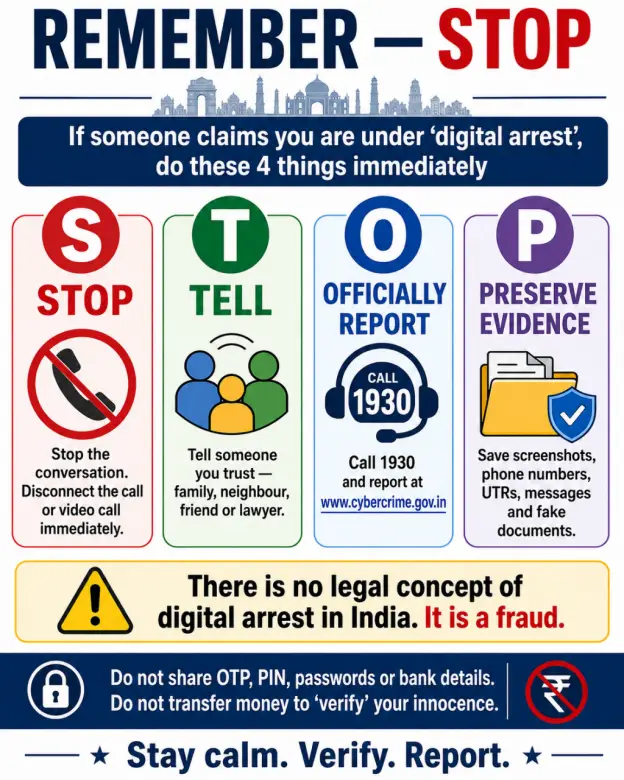
16. Remember “STOP”
- S — Stop the conversation. Do not continue the call or video call.
- T — Tell someone. Call family, neighbour, lawyer, police station or trusted person.
- O — Officially report. Call 1930, inform bank, file complaint at cybercrime.gov.in.
- P — Preserve evidence. Save numbers, screenshots, UTRs, fake documents, account details and call records.
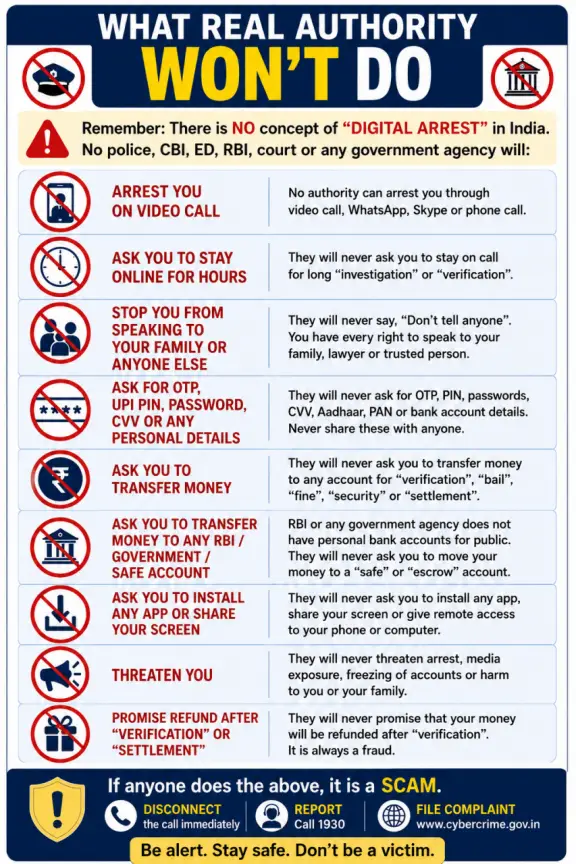
17. What no real authority will do
A real police officer, CBI officer, ED officer, RBI officer or court officer will not:
- Arrest you on video call, this is illegal.
- Ask you to stay online for hours.
- Stop you from speaking to your family or lawyer.
- Ask for OTP, UPI PIN or password.
- Ask you to transfer money to prove innocence.
- Ask you to break fixed deposits.
- Ask you to install screen sharing apps.
- Threaten immediate arrest if you disconnect.
- Promise refund after “verification”.
18. Final citizen checklist
Before transferring money, ask yourself:
- Have I independently verified the caller?
- Have I called my local police station?
- Have I spoken to my family or lawyer?
- Am I being told to keep the matter secret?
- Am I being asked to transfer money to prove innocence?
- Am I being asked to stay on video call?
- Am I being threatened with arrest or public shame?
- Am I being rushed?
If the answer to any of these is yes, do not transfer money.
Disconnect. Call 1930. Inform your bank. Speak to a trusted person.
Closing message
Digital arrest fraud succeeds because victims are isolated, frightened and rushed. The solution is to break the isolation.
No one should feel embarrassed after being targeted. These are organised criminal networks using fear, technology, fake authority and psychological manipulation.
The safest response is:
Do not panic. Do not pay. Do not stay on video call. Do not keep it secret. Report immediately.
Rtn. Vaishali Bhagwat, Advocate
The Author is a practicing lawyer with special expertise and experience in cyber law for over 25 years.